Every once in a while a bread releases from its pan and delivers so much flavor that you cannot believe it is even related to loaves bagged in plastic in the bread aisle.
This recipe from Melissa Johnson at Breadtopia can be made with either buckwheat porridge or buckwheat flour. I made this loaf with freshly milled buckwheat flour and freshly milled heirloom wheat (Turkey Red). It is a loaf where you can actually taste the richness of slowly baked grains, gently browned in the oven after a slow deliberate fermentation.
And some ciabattas, because who doesn’t like ciabattas fresh from the oven?
I do not believe in growing summer squash or zucchini. Too many people insist that you take theirs. So when several unasked for squashes were given to us, I hunted for recipes that might use them up and include sourdough. I came across Sourdough Summer Squash Milk Bread. It is an enriched bread with egg, sugar, and a tangzhong, which is a roux made of flour heated with (in my case soy) milk, until it forms a thick paste. It also has a generous cup of grated squash and sourdough.
Super moist, rich, and stayed fresh for days.
Look closely for the baked flakes of yellow squash.
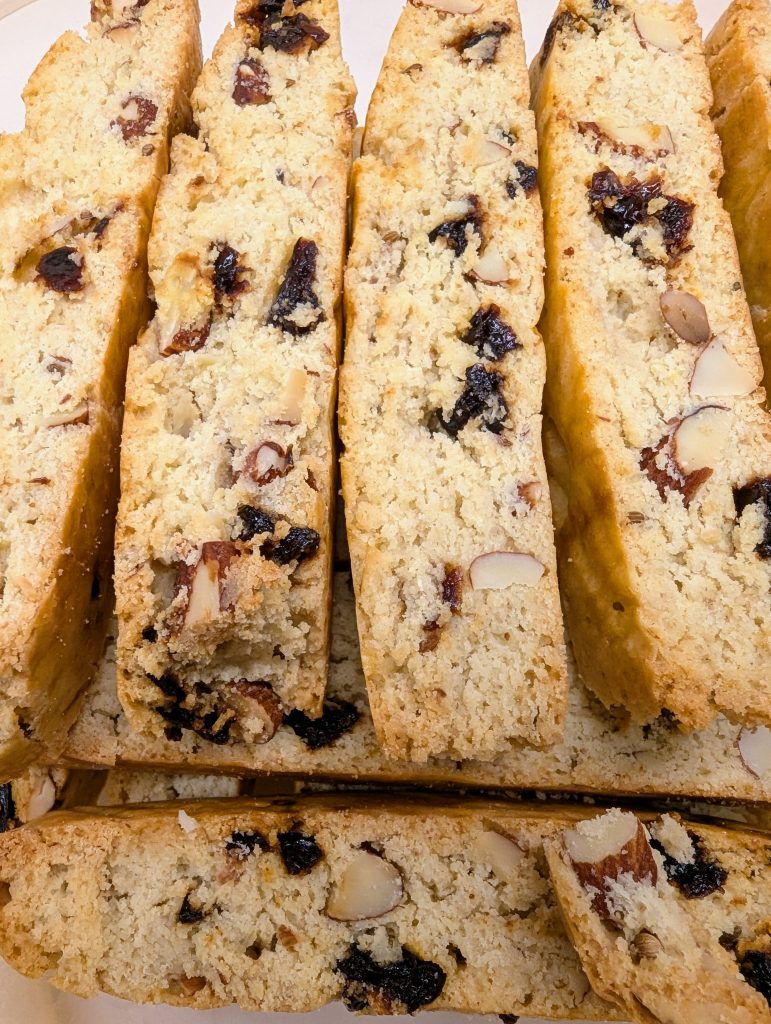
About a week later, with my wife Susan’s necessary assistance, we tried our hands at The Perfect Loaf’s Sourdough Cherry Almond Biscotti. The photographs speak for themselves.
I have always wanted to see important trade stops on the ancient Silk Road, and observe firsthand how a Former Soviet Republic is finding its way. When I saw how bread bakers in Uzbekistan dived headfirst into their tandoors to bake their bread, I had reason to learn as much as I could (during a 12-day visit) about the breads of Uzbekistan. The rest of the story…
For thousands of years, Jewish families have baked challah, the iconic braided bread that graces Sabbath tables worldwide. While many know it for its glossy crust and soft interior, its origins trace back to biblical times as a divine gift of sustenance. In this guest post from Eric Pallant, we explore how a simple portion of dough became one of Judaism’s most enduring traditions.
I admit that I am envious of bakers who make their loaves using fresh, locally raised grains. It sounds like the ideal—for flavor, for community, for the environment. But I am also a little skeptical. Is local flour really any better than flour made with grain from far away? What are my options if I want heirloom wheat or ancient grains to bake with and they aren’t grown anywhere near me? What if I want to buy organic grains but my local farmers say that organic certification is not worth the cost? Should I just trust their practices because I like them? Is it even worth the extra cost to pay for local or organic?
Every sourdough baker recalls who gave them their starter, or how they made their own. I have made it a practice to share My Three Starters (for those of you of a certain age, I apologize for putting the insipid jingle for My Three Sons in your head), though I sell them now, mostly so I am not inundated by too many requests.
Now that one of my longest-running sourdough friends moved with her Cripple Creek starter from Germany to Australia, I can now say that sourdough starters I bake with are alive and leavening loafs on every continent except Antarctica.
Unless you pay very close attention, you won’t taste the sourdough in the cookie. The long fermentation time, however, does cut the overall sweetness of the cookie, allowing the ice cream to shine. You won’t feel like you are about to get diabetes from eating this concoction. Nor will you have any difficulty finishing a whole ice cream sandwich.
Ingredients
200-210 g All Purpose Flour
200 g Brown sugar
80 g Melted butter (6 TBS)
1Egg
60 g Sourdough Starter – I use a whole wheat starter
4 g Salt (1 tsp)
4 g Baking Soda (½ tsp)
2/3 Cup Mini Dark Chocolate Chips or to your liking!
ICE CREAM:
Vanilla Ice Cream
TOPPING:
Mini Dark Chocolate Chips
Instructions
In a small bowl, whisk 1 egg in a medium bowl.
Melt butter until it becomes liquid (warm but not hot). Now add brown sugar, sourdough starter, salt, and butter to the medium bowl (with the egg).
Mix ingredients together until combined.
Now add flour, chocolate chips, and baking soda. Using the back of your spoon and/or your hands combine all ingredients until you form a ball.
Place your dough covered in a small Tupperware or wrap it in saran wrap. Be sure the dough is tightly sealed so it doesn’t become dry on the outside.
Ferment your dough (at room temperature) on your counter for 24 hours..
Before baking, chill the dough for at least 30 minutes or it will be sticky and difficult to manage.
When you’re ready to bake, preheat your oven to 350 f.
Press 30 grams of cookie dough to fill a greased, smooth ring like an English muffin ring. A small mouth mason jar ring can work, but its ridges make the cookie difficult to extract.
Without a ring the cookie will spread to more than double the diameter.
Place on a baking sheet and bake for 8-10 minutes or until lightly browned on the sides. The centers will look soft.
As soon as you can use a spatula to remove the cookies from the pan and ease them out of their rings. Allow to cool completely on a wire rack.
Flip a cooled cookie over and place a scoop of ice cream on top. Use your scoop to gently spread the ice cream to the edges. Sandwich a cookie on top and gently press it all together.
Optional: Roll sides into mini chocolate chips. Be quick during this process!
Now place the ice cream sandwiches on a plate and place them in the freezer for 15 minutes (so it firms up a bit). And that’s it! Enjoy!
If you’re not enjoying them right away, keep ice cream sandwiches on the plate in the freezer until it’s completely firm (this can be 2-3 hours or overnight) and then place them in a freezer bag or closed Tupperware
NOTES: One recipe makes about 24 cookies or one dozen ice cream sandwiches. For other sourdough sweets and cookies see Jesha’s Sourdough.
Andrew Janjigian, a world-class baker, chef, recipe tester, and recipe writer recently published a terrific rant on the uselessness of sourdough discard. (Often sourdough bread recipes expect very exacting amounts of sourdough starter and when preparing a sourdough starter the night before a bake, it is not always possible or practical to hit a target in the bullseye. Hence, leftovers also known as sourdough discard.) Janjigian’s thoughts are that tiny amounts of sourdough added to a recipe, often without anytime to actively ferment, are mere tokenism. And if there is going to be enough sourdough starter to make a difference in a recipe, why not go all the way and make your baked-thingy a sourdough one.
Nonetheless, Janjigian finds it no easier than any of the rest of us to discard excess starter. He is a real precisionist baker so he is much more likely than me to have some leftover. I’ve been working through a handful of recipes that he recently published for using sourdough discard. I’m not certain if you have to subscribe to his substack like I have in order to see the recipes and for that reason will not be publishing his recipes here. Go to his website yourself and look at his newsletters.
Sourdough Granola
I could not believe how good this was. The sourdough glop, mixed with olive oil, honey, and vanilla coats the oats and unsweetened coconut and then in the low-temperature oven slowly bakes into, well, a sweetbread coating. It was so addictive that I made a second batch using a rye starter and some local strawberries I had just dried.
Sourdough Korean Style Pancakes
We (my son Isaac is an excellent cook and he joined me for a day in the kitchen) used fresh corn, and chopped fresh scallions, diced garlic scapes, and finely chopped carrots and daikon. We made a thin batter with the sourdough. We fried in vegetable oil and served with two kinds of kimchi and a spicy soy-vinegar-gochuguaru dipping sauce.
Rebecca Firsker published this recipe for a sourdough discard cake in a recent posting to The Perfect Loaf. My version of the cake was denser and chewier than what I’m used to for a lemon poppyseed cake, but it was oh, so-lemony. It lasted a day-and-a-half.
Deep Fried Whole Wheat Poori with Cumin
I was making a vegan red lentil almond dal the other night. Usually, when I make dal, I also prepare some sourdough naan to go with it, but, just to change things up, I revived this old recipe from Flatbreads & Flavors by Jeffrey Alford and Naomi Duguid.
Here is a quick summary of their recipe.
2 cups atta flour (sifted whole wheat, but I just used freshly milled whole wheat flour)
1 cup unbleached white flour
1 tsp black pepoper
1 tsp ground cumin
1/2 tsp turmeric
1 tsp salt
1 Tablespoon veg oil or ghee
1 1/2 cups plain yogurt, or more as necessary
Oil for deep frying
Mix flour, spices, salt in a bowl.
Sprinkle in the oil and rub in with your fingers.
Add yogurt a little at a time until kneadable; should be stiff but kneadable.
Knead dough on lightly floured surface 8 – 10 minutes.
Return dough to lightly oiled bowl, cover, let rest 30 min – to two hours.
Divide dough into 16 balls. Flatten each ball with your palms, cover with plastic, do not stack.
Roll pooris to 6 inches diameter, cover, do not stack.
Heat oil to 375 degrees.
Lay poori on oil. It sinks. When it rises, poke it with spoon until it puffs Turn over and cook another 10 – 15 seconds.
Every year for as long as anyone can recall, Uncle Marty (left), Sue’s (right) brother, arrives from California. Beginning before Christmas and lasting through the New Year he prepares gourmet meals. I make breads to try to keep up.
Homemade duck breast pastrami.
Served on Menhir au Ble Noir, a rustic French sourdough bread made with buckwheat flour.
One night Leah made Twisted Spinach Breads…
And another night, Marty made Burmese Coconut Curry stew with Striped Bass and Gun Gun noodles.
As we always do we make homemade sourdough bagels to have with lox. This year: TWICE.
I’ve mastered, and altered, Maurizio Leo’s Sourdough Scones with Khorason flour. A stick and a half of butter, how can I go wrong? Using freshly milled heirloom grains makes a world of difference, too.
When I made them a second time, I was outshined by a delivery of fresh goodies driven in from Chicago bakeries and Arab food markets. Thank you Leah and Wisam.
One evening Marty made a turkey dinner with all the fixings
So I made a Jewish Deli Rye — I’ve finally mastered that one — to have with turkey sandwiches and a Cranberry Walnut Bread.
Which we ate with Vegan Cauliflower Soup.
Near the end of his stay, I made Sourdough Calzones with Spinach and Mushroom fillings.
And Marty’s visit is always closed out with Danish Rugbrod, a dense rye loaded with, in this version, whole oat groats, wheat grains grown here in Crawford County, whole Einkhorn grown in the southern tier of New York State, pumpkin seeds, flax seeds, and sunflower seeds.